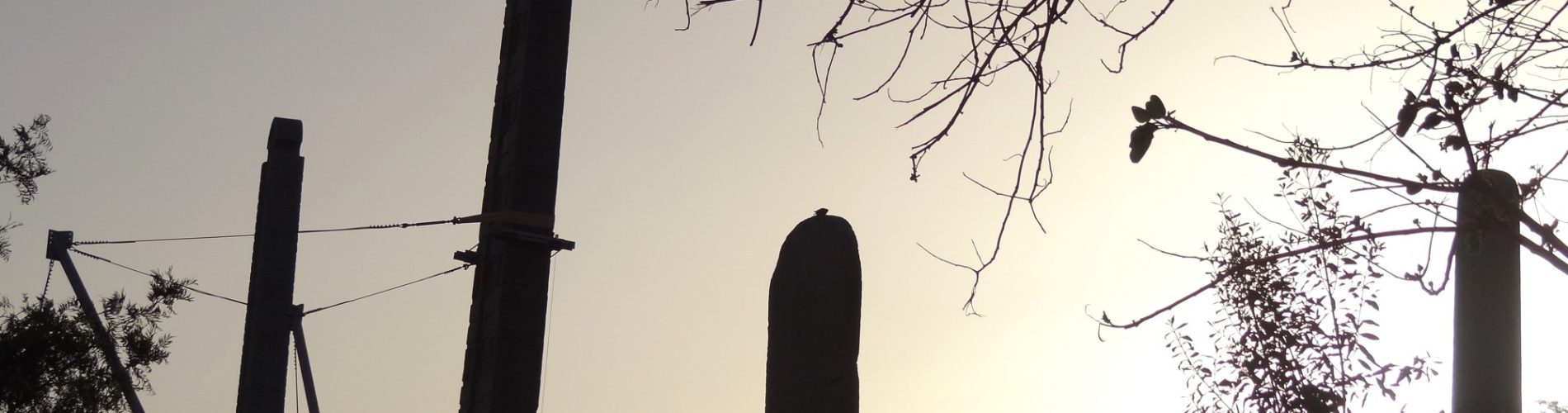
In the highlands of Tigray, close to Ethiopia’s northern border, a field of granite-like monoliths rises above the town of Aksum. They are the most famous monuments of the Kingdom of Aksum, a state that UNESCO describes as having been, in its time, the most powerful between the Eastern Roman Empire and Persia. Inscribed on the World Heritage List in 1980, the ruins of Aksum date from between the 1st and the 13th century AD and include monolithic stelae, royal tombs and the remains of palaces. The great stelae are its signature image.
A kingdom at the crossroads
Aksum flourished from roughly the 1st to the 8th century AD. Its rulers sat at a junction of Africa, Arabia and the Greco-Roman world. Through the Red Sea port of Adulis, Aksumite merchants traded ivory, gold and other goods with Egypt, the Mediterranean, Arabia and India. From the late 3rd century Aksum minted its own coins in gold, silver and copper, modelled on Roman standards; the gold issues were used mainly in international trade. In the 3rd century the Persian prophet Mani named the kingdom of the Aksumites as one of the four great kingdoms of the world, alongside Persia, Rome and China.
The kings also left written records. Stone inscriptions found in Aksum, some of them trilingual in Greek, Sabaean and Ge’ez, were set up by King Ezana in the 4th century. UNESCO calls them of immense importance to historians of the ancient world.
Skyscrapers in stone
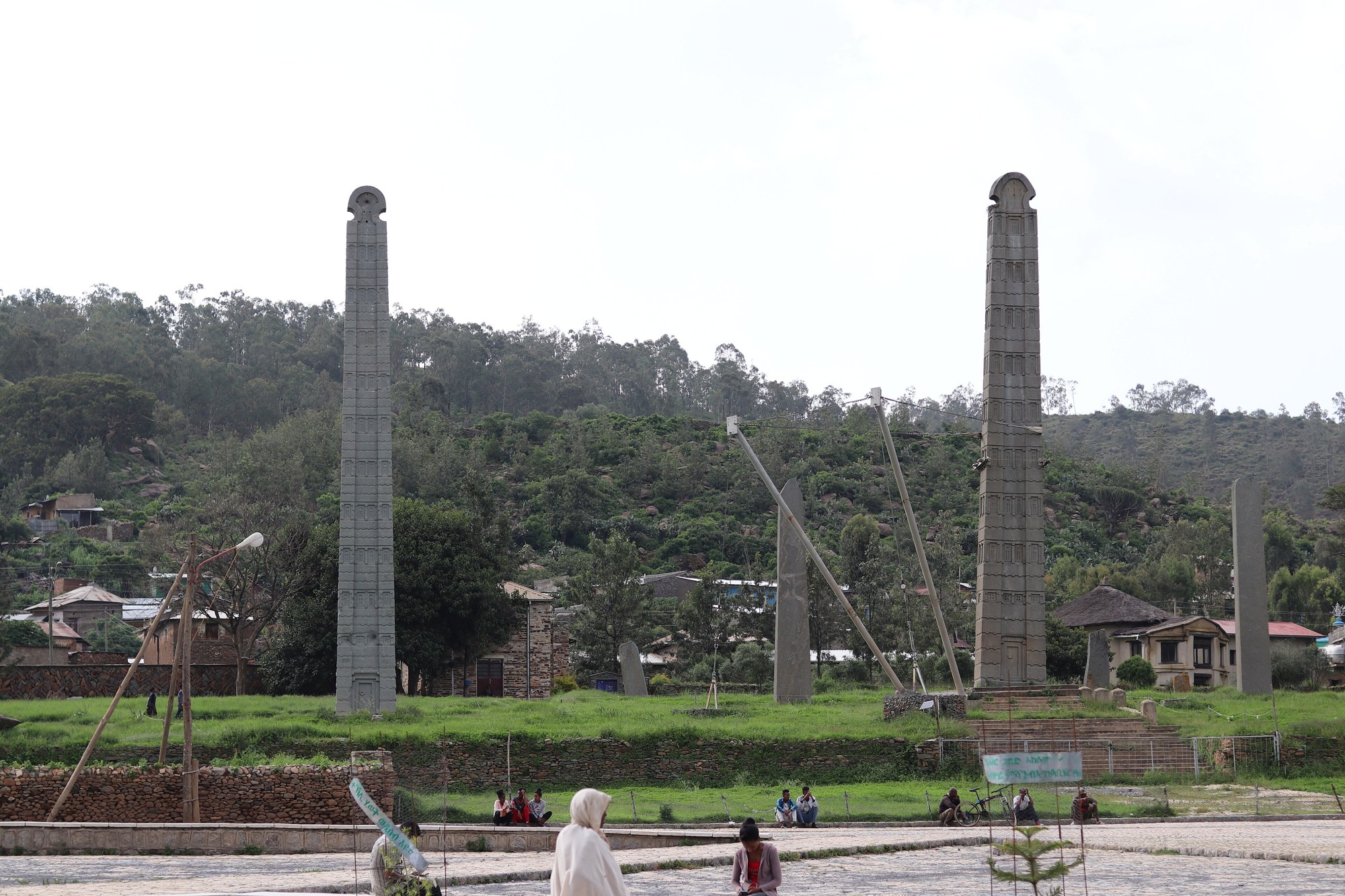
Aksumite stelae (in local languages hawelti) are usually called obelisks, but strictly they are stelae: they do not taper to a point like Egyptian obelisks, and they end in a rounded top. Most of them mark underground burial chambers. Hundreds of stelae survive in Aksum’s stelae fields, from rough, undressed slabs to the elaborate royal monuments, which UNESCO dates to the 3rd and 4th centuries AD.
The royal stelae are carved to look like tall buildings. Each storey is marked by rows of false windows and by beam ends, known as ‘monkey heads’, copied from the timber-and-stone architecture of Aksumite palaces. A false door, complete with a carved lock, sits at the base. The stone came from quarries in the hills west of the town and was moved to the site and raised without the help of modern machinery. How exactly that was done is still debated by archaeologists.
The Great Stele
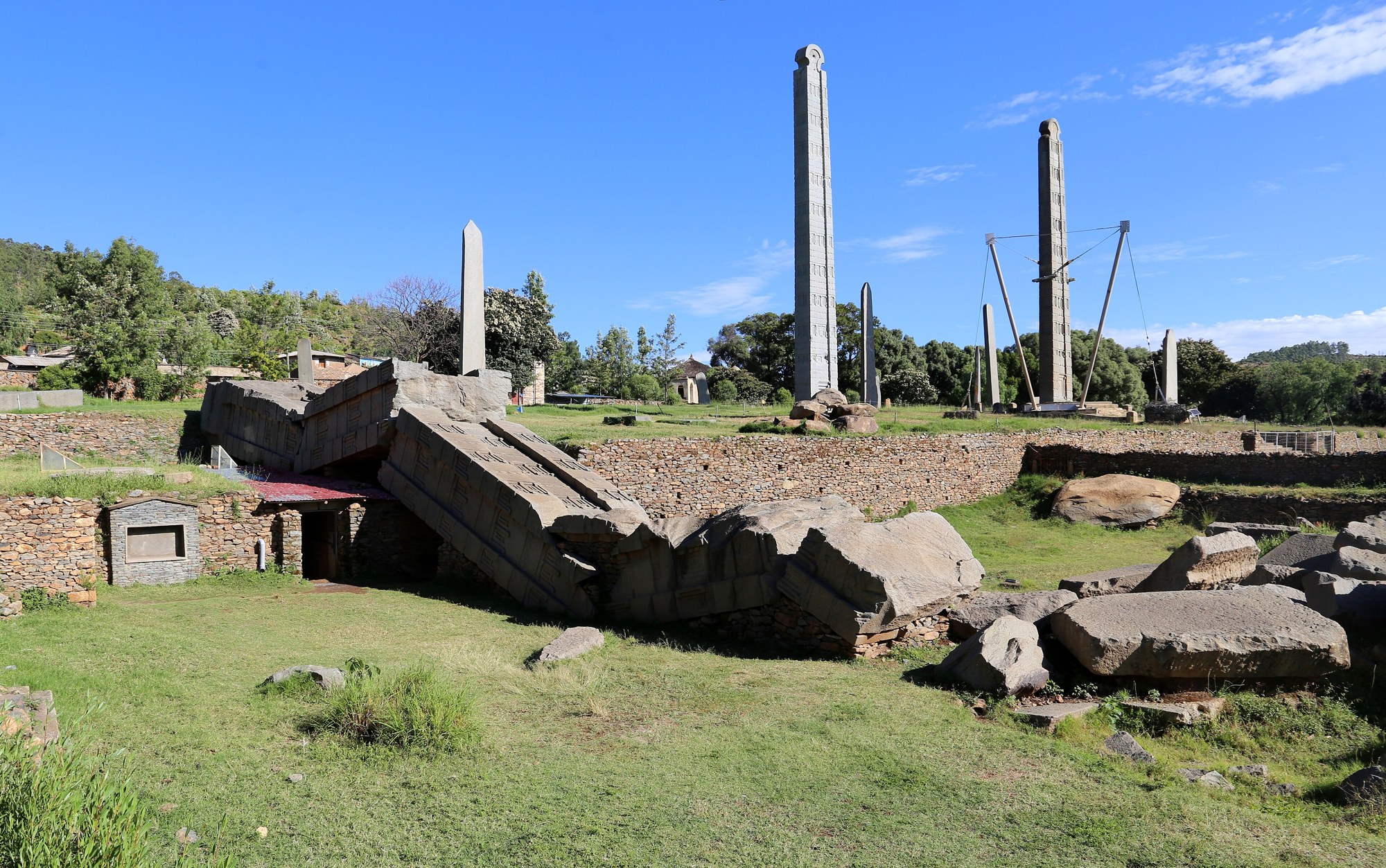
The largest of all, known as the Great Stele or Stele 1, is about 33 metres long. It lies broken on the ground where it fell, possibly during the attempt to raise it. UNESCO notes that it may be the largest single stele that ancient people ever tried to stand upright. The archaeologist David Phillipson suggested that cracks in the adjacent underground tomb known as the Mausoleum may have been caused by the shock of its fall. Other researchers have argued that the stele may instead have been pulled down deliberately, so how it came to fall remains debated.
That change also matches a major religious shift. In the 4th century King Ezana, tutored as a young man by Frumentius, a Syrian Christian from Tyre who became the first bishop of Aksum, adopted Christianity, and Aksum became one of the earliest states to do so officially. Ezana’s later coins replace the old crescent-and-disc symbol with the cross. Royal burials under huge stelae did not continue in the Christian era.
King Ezana’s Stele
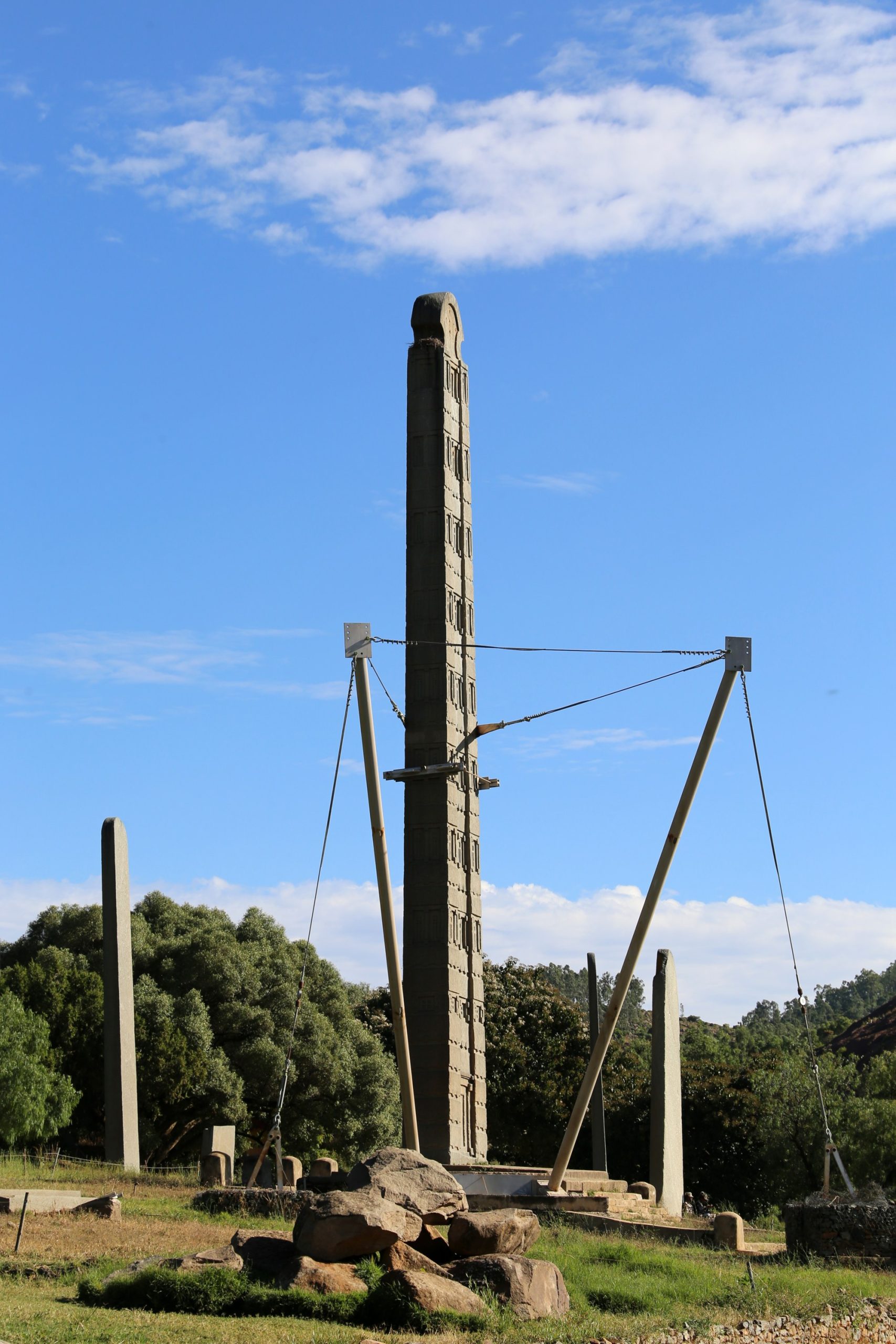
The stele that has stood the longest is the one traditionally named after King Ezana (Stele 3). About 21 metres tall and carved on all sides, it is probably the last of the great stelae to be erected, and the only one of the three largest that never fell. When European travellers such as Henry Salt drew Aksum in the early 19th century, it was the only one of the three great royal stelae still standing. It still stands in the main stelae field today.
A journey to Rome and back
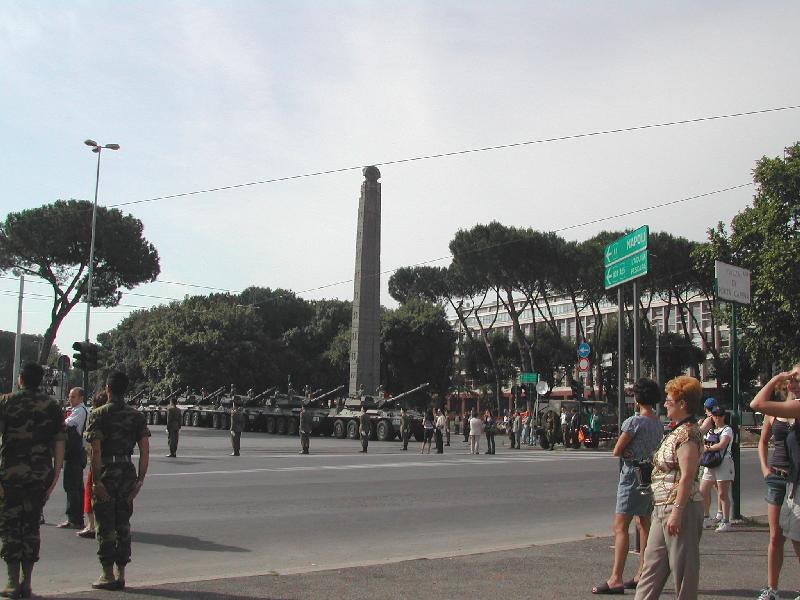
The second-largest royal monument, about 24 metres tall and known as Stele 2 or simply the Obelisk of Aksum, had a very different history. It was already lying in pieces when, in 1937, during the Italian occupation of Ethiopia, it was taken to Italy as a war trophy. It was cut into sections, shipped from Massawa, and set up in Rome’s Porta Capena square, where it was unveiled on 28 October 1937.
Under the 1947 peace treaty, Italy agreed to return objects taken from Ethiopia, but the stele stayed in Rome for decades. On 27 May 2002 it was struck by lightning. Italy finally dismantled it in 2003, and its three sections were flown to Aksum on 19, 22 and 25 April 2005 aboard an Antonov An-124 cargo aircraft, after the runway at Aksum’s airport had been improved for the purpose. A team chosen by UNESCO and led by the Italian engineer Giorgio Croci reassembled the stele in its original setting, and it was unveiled on 4 September 2008.
Aksum today
Aksum is still a holy city for Ethiopian Orthodox Christians. The Church of St Mary of Zion, rebuilt in the Gondarine period in the 17th century, is believed by the faithful to hold the Ark of the Covenant, and Ethiopian emperors continued to be crowned in Aksum long after the kingdom’s political decline. UNESCO notes ongoing conservation concerns, including modern houses built over buried Aksumite structures and flooding in some tombs.
For visitors, the stelae field remains one of the most remarkable sights in Africa: a forest of carved stone left by a trading empire that minted coins, wrote in its own script and raised the tallest monoliths of the ancient world.
Sources
- UNESCO World Heritage Centre, “Aksum” (inscribed 1980): whc.unesco.org/en/list/15
- Metropolitan Museum of Art, Heilbrunn Timeline, “Eastern and Southern Africa, 500–1000 A.D.”: metmuseum.org
- David W. Phillipson, Ancient Ethiopia: Aksum, Its Antecedents and Successors (British Museum Press, 1998)
- David W. Phillipson, “Aksum: An African Civilisation in its World Contexts,” Proceedings of the British Academy 111: thebritishacademy.ac.uk
- Britannica, “Saint Frumentius”: britannica.com
- Smarthistory, “Aksumite coins”: smarthistory.org
- Stuart Munro-Hay, Aksum: An African Civilisation of Late Antiquity (Edinburgh University Press, 1991)
- BBC News, “Obelisk arrives back in Ethiopia” (19 April 2005) and “Ethiopia unveils ancient obelisk” (4 September 2008)