The cross is everywhere in Ethiopian Orthodox life, carried in processions, held by priests and worn by believers. One of the most important celebrations of the year is Meskel. According to UNESCO, which added it to its Representative List of the Intangible Cultural Heritage of Humanity in 2013, Meskel is celebrated across Ethiopia on 26 September to commemorate the unearthing of the True Holy Cross of Christ.
UNESCO describes celebrations that begin with the building of the Damera bonfire in Meskel Square in Addis Ababa, a conical pyre decorated with green grass and Abyssinian daisies symbolising the New Year. Priests chant hymns and dance in front of the pyre, and the patriarch of the Ethiopian Orthodox Tewahedo Church lights the bonfire. Before the celebration, UNESCO says, personal quarrels and disagreements must be resolved.
Roots in Aksum
Christianity in Ethiopia goes back to the 4th century. Encyclopaedia Britannica records that Frumentius, later consecrated the first Ethiopian bishop, won the confidence of the king at Aksum, and that the succeeding king, Ezana, was baptized and made Christianity the state religion.
Processional crosses
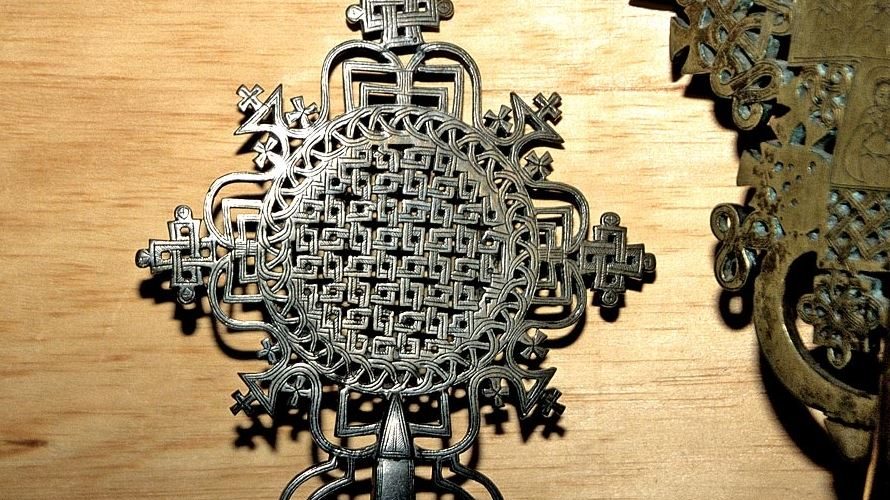
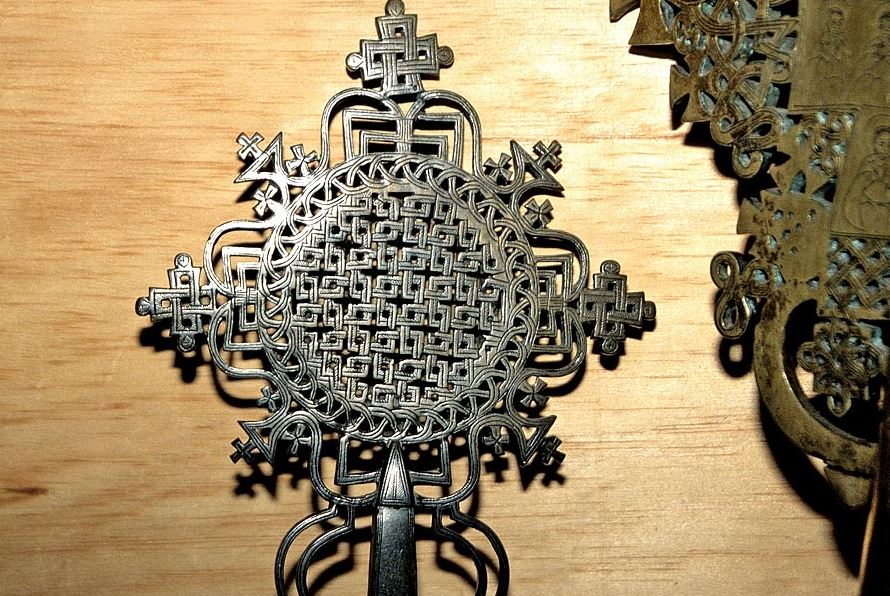
Large metal crosses with intricate openwork, like the one above, are carried above the crowds during church processions. Their lattice designs vary widely from one cross to another.
Hand crosses
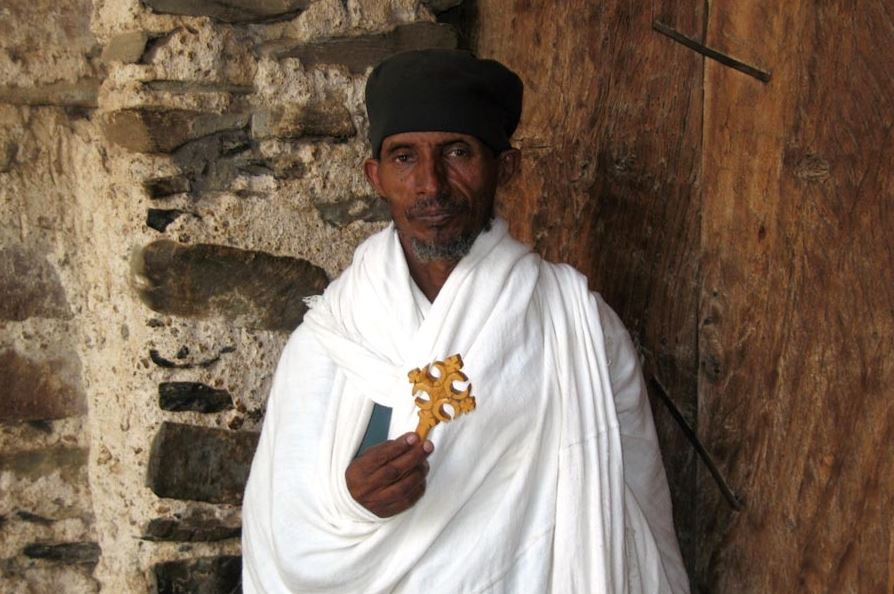
Priests often carry a smaller hand cross, which believers kiss when they meet. The photograph below shows a man in a white shawl holding a small wooden cross.
Crosses on churches
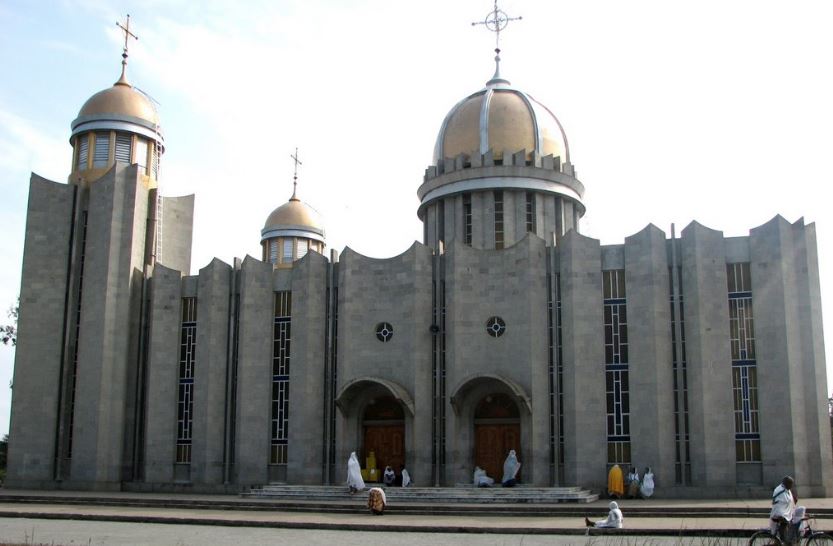
Crosses also crown church roofs and domes, as on the large stone church below. The tabot, or ark, kept inside every church is the other essential sacred object of the tradition, Britannica notes.
The cross on Aksum’s coins
Some of the earliest evidence for the cross in Ethiopia comes from coins. According to the Metropolitan Museum of Art, Aksum began minting coins in the 3rd century, and after his conversion King Ezana (reigned about 320 to 350) removed the crescent and disc of South Arabian polytheism from his coins and replaced it with the Christian cross. The archaeologist David Phillipson notes that the king’s conversion is also confirmed by a letter of AD 356 from the Roman emperor Constantius II, preserved in the writings of Saint Athanasius (Phillipson, 2009).
A study of Ethiopian crosses published by University College London adds that later Aksumite coins, from the 4th to the 6th century, show the cross in many settings: beneath an arch, within a hexagon or a wreath, or on top of a building. Christians wore crosses around their necks, rulers held sceptres topped with crosses, and churches could be built on a cross plan, the study says.
Sources
- UNESCO Intangible Cultural Heritage, Commemoration feast of the finding of the True Holy Cross of Christ
- Encyclopaedia Britannica, Ethiopian Orthodox Tewahedo Church
- The Metropolitan Museum of Art, Foundations of Aksumite Civilization and Its Christian Legacy
- David W. Phillipson, Aksumite civilization, its connections and descendants, Mitteilungen der Sudanarchäologischen Gesellschaft 20 (2009)
- UCL Discovery, Ethiopian Crosses: Art in Motion