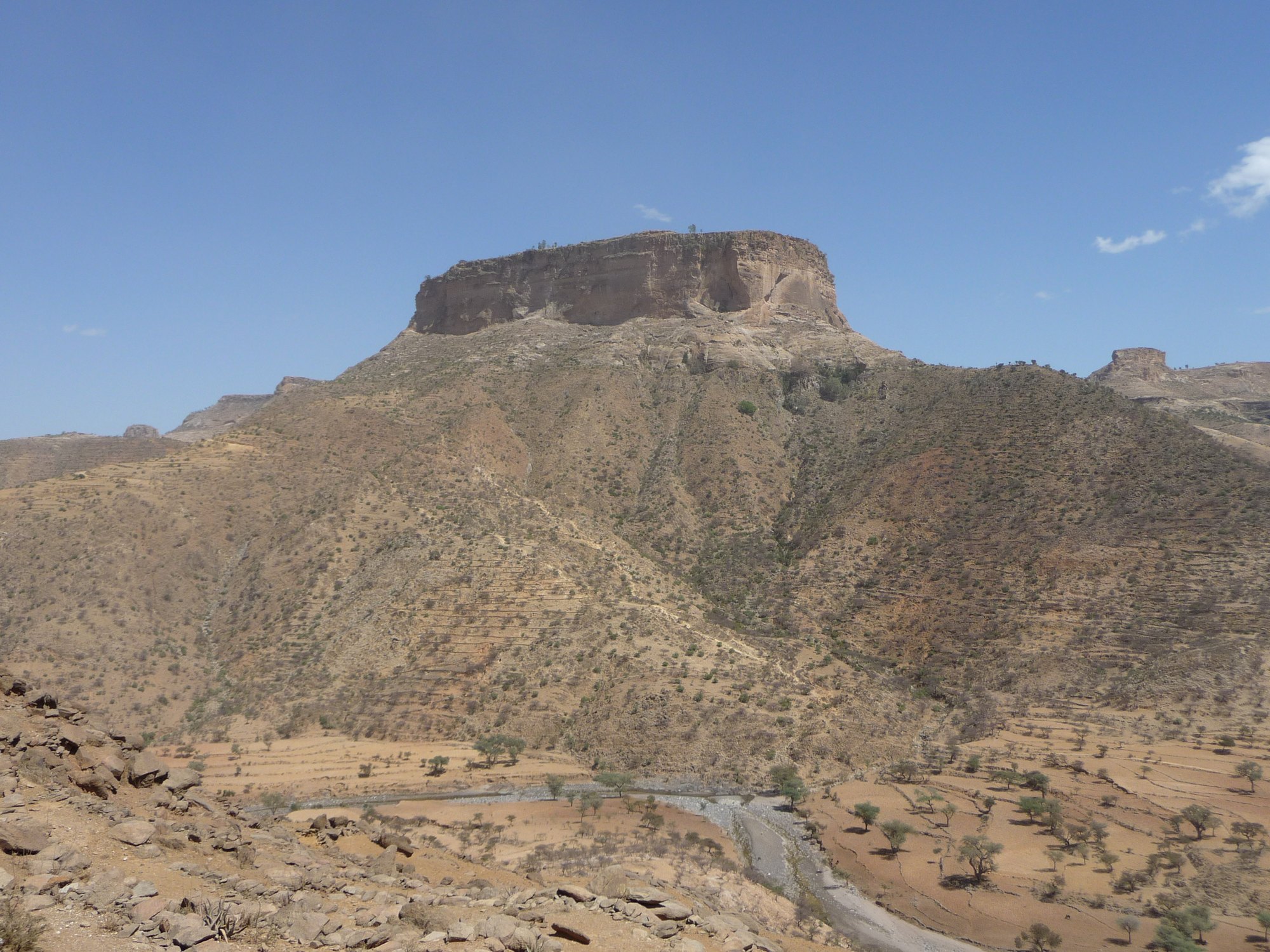
Debre Damo, a monastery on a sheer sided mountain in northern Tigray, can be reached only by a rope up a cliff. Its main church is counted among the oldest standing in Ethiopia.
An island in the sky
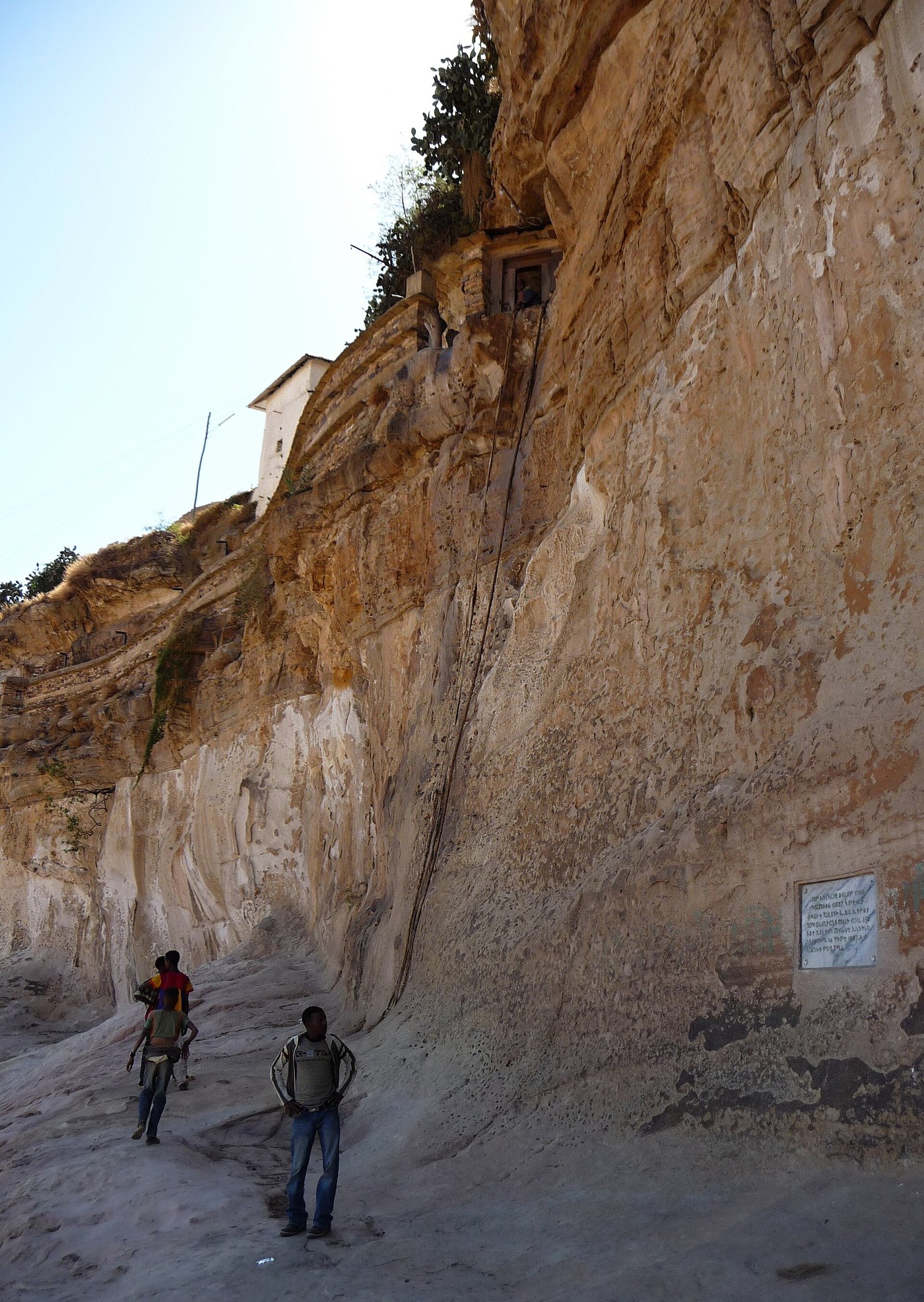
Debre Damo stands on an amba, the name for the flat topped, cliff ringed mountains of the northern highlands. The Lonely Planet guide describes a climb up a sheer cliff of about 15 metres on a thick leather rope, while monks tie a second line around each visitor and help haul them to the top. Only men may make the climb, and the guide adds that even the livestock kept on the summit are male.
According to the same guide, some 150 monks live on the plateau and support themselves, growing crops, raising animals and storing water in reservoirs cut deep into the rock.
A saint and a serpent
Tradition credits the founding of the monastery to Abuna Aregawi, one of the Nine Saints, a group of monks whom Ethiopian Church tradition credits with spreading Christianity in the north. Lonely Planet links the foundation to the sixth century reign of the Aksumite king Gebre Meskel. In the legend the guide retells, God sent a giant serpent that lowered its tail over the cliff so Aregawi could climb to the summit.
An Aksumite church, rebuilt in 1948
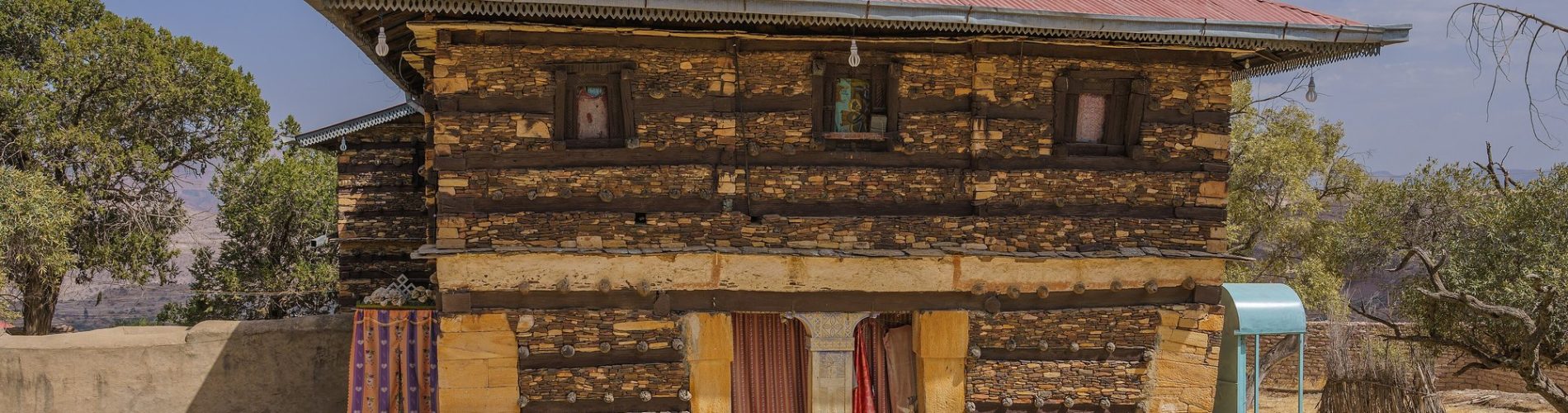
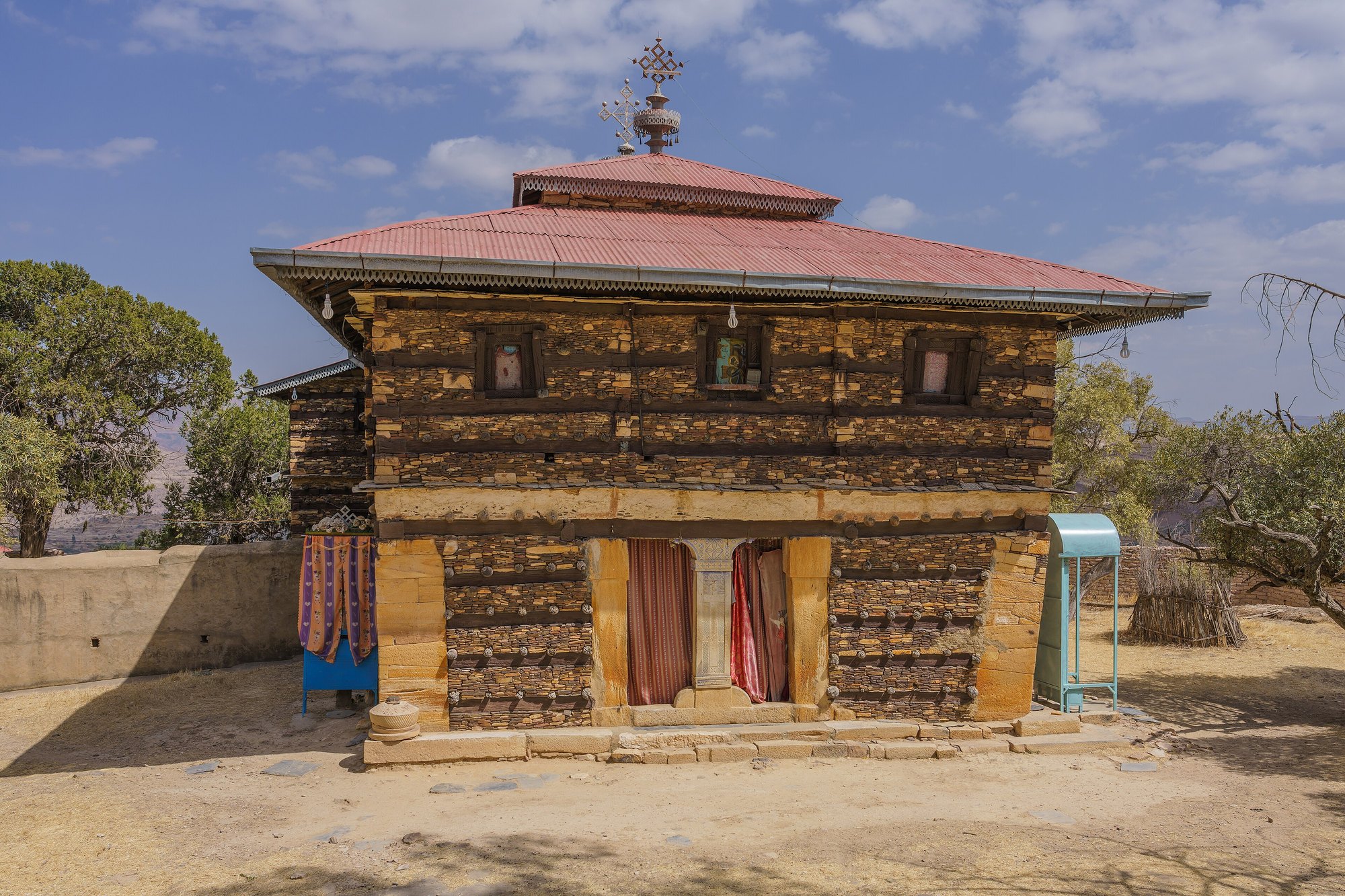
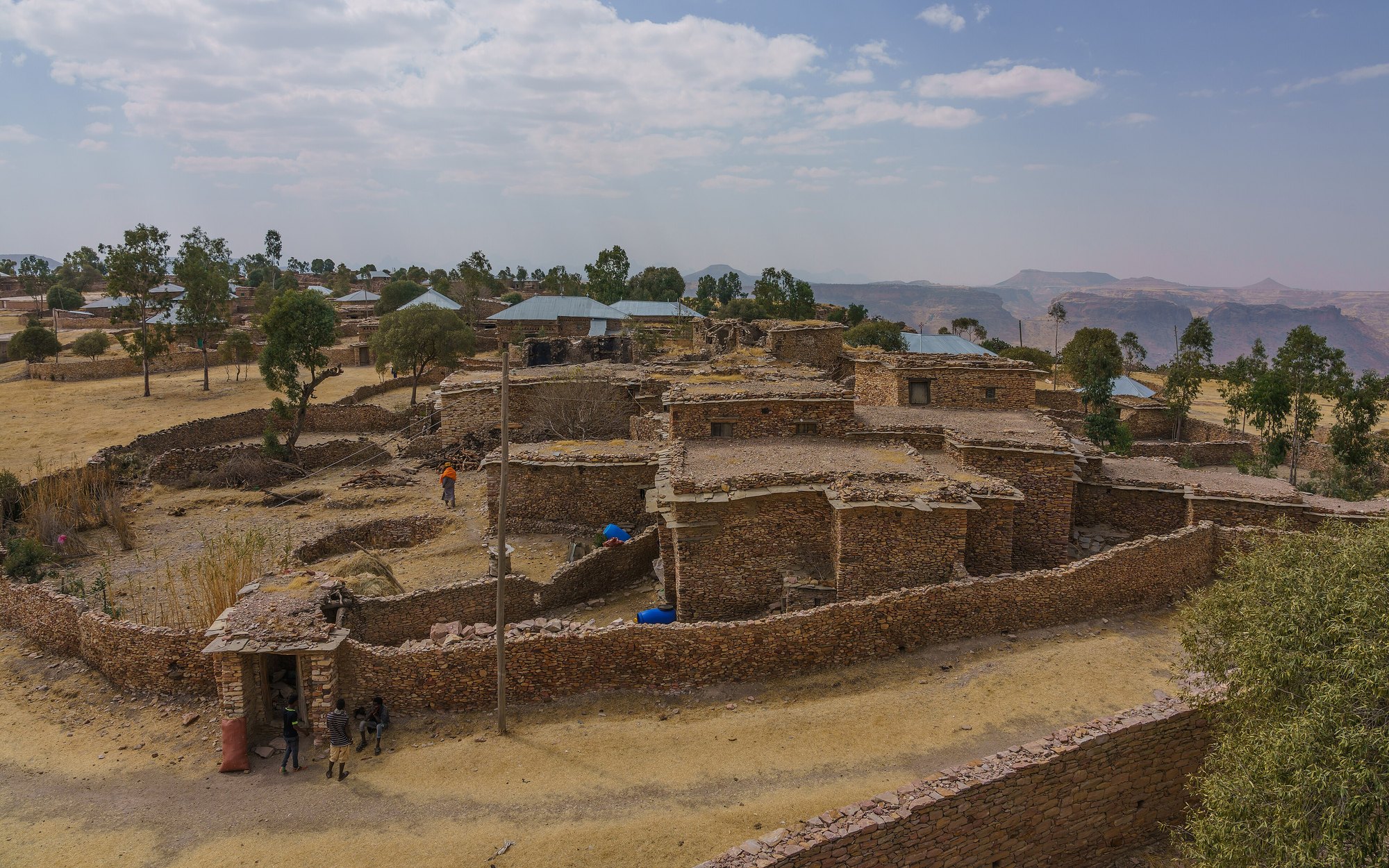
The main church owes its fame to its construction. In their 1959 monograph for the Society of Antiquaries of London, the architect Derek Matthews and the Italian researcher Antonio Mordini described it as one of the few surviving examples of an ancient style of Ethiopian architecture. Lonely Planet notes that its doors and windows follow the same design carved on the stelae of Aksum, and that its ceiling is famous for carved wooden panels showing animals.
By the 1940s the building was failing. Matthews wrote in Antiquity in 1949 that David Buxton had found it in a state of collapse, and that efforts by O. G. S. Crawford, the Society of Antiquaries and the British Council led Emperor Haile Selassie I to agree to spend up to £5,000 on repairs, with Matthews as architect in charge. He first reached the monastery on 14 February 1948.
How old the church is remains debated. The archaeologist David Phillipson, in Ancient Churches of Ethiopia (2009), has argued that its original plan may go back as far as the sixth century, with parts of the building added later. Lonely Planet gives a later estimate, the tenth or eleventh century.
Treasures from far away
The monastery has also kept objects from distant lands. The Encyclopaedia Aethiopica records gold coins of the Kushan kings from the second century AD, along with Arab coins of the Umayyad and Abbasid periods, and Islamic textiles with Arabic inscriptions found in the main church. Mordini’s account, quoted by the historian Susan Whitfield in Silk, Slaves, and Stupas (2018), says that early in 1940 a young monk repairing a wall in the cemetery area found the remains of a wooden box and a large number of gold coins in a small cave. The coins were later sold, and the numismatist Robert Göbl published a study of the hoard in 1970.
Sources
- Lonely Planet: Debre Damo
- Matthews, D. H. and Mordini, A. (1959), The Monastery of Debra Damo, Ethiopia, Archaeologia 97, pp. 1 to 58
- Matthews, D. H. (1949), The Restoration of the Monastery Church of Debra Damo, Ethiopia, Antiquity 23, pp. 188 to 200
- Encyclopaedia Aethiopica, vol. 2 (2005), entry Däbrä Damo (print)
- Phillipson, D. W. (2009), Ancient Churches of Ethiopia: Fourth to Fourteenth Centuries, Yale University Press (print)
- Whitfield, S. (2018), Silk, Slaves, and Stupas: Material Culture of the Silk Road, University of California Press (print)
- Göbl, R. (1970), Der Kušānische Goldmünzschatz von Debra Damo, Äthiopien, 1940, Central Asiatic Journal 14 (BnF catalogue record)