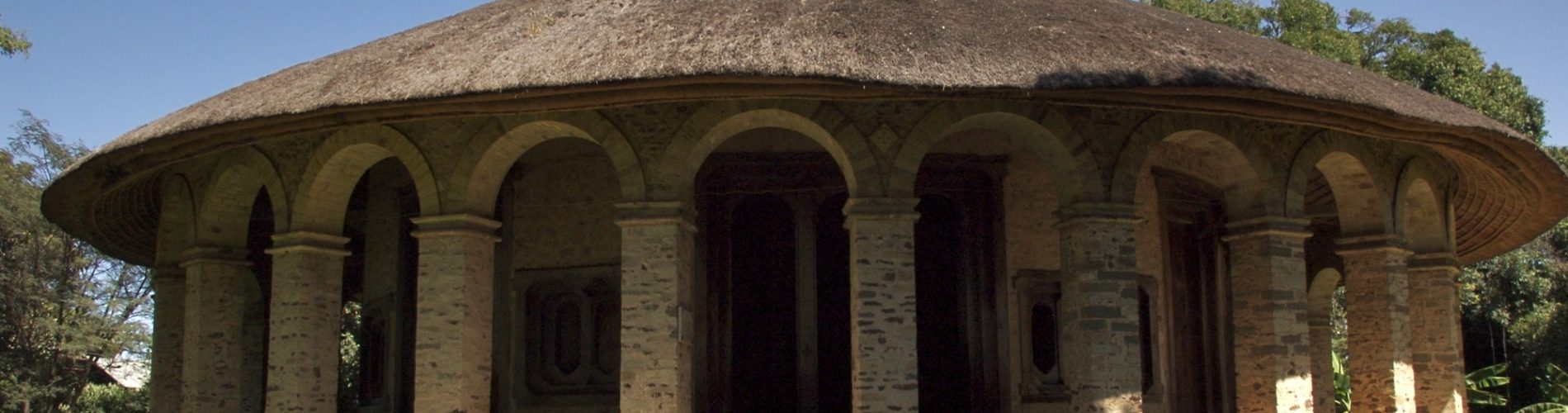
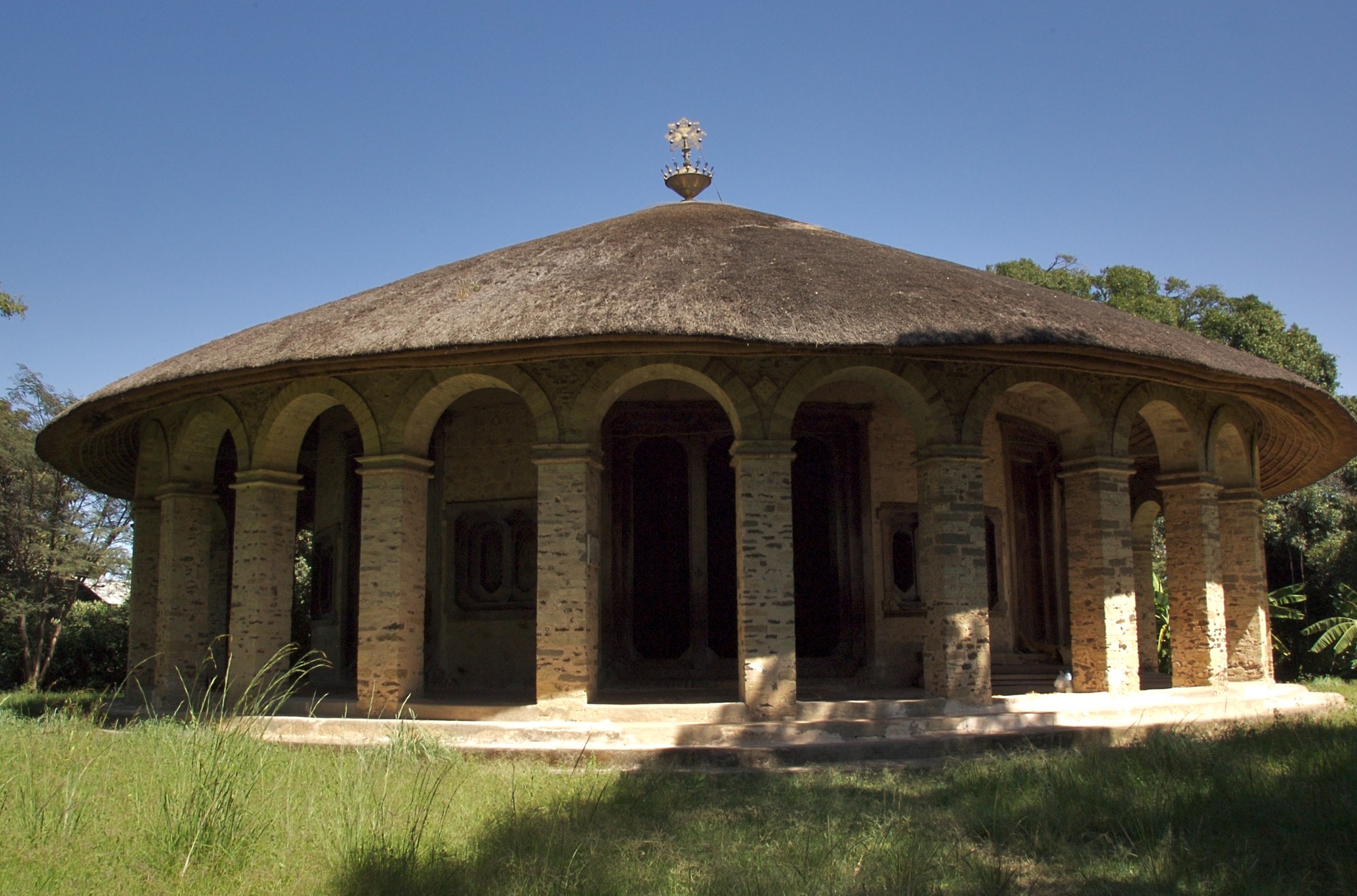
On a small island beside Dek, the largest island in Lake Tana, stands Narga Selassie, a round church founded by Empress Mentewab in the 1730s and decorated under her supervision.
An empress’s island church
Narga Selassie, also written Narga Sellase, stands on the islet of Narga next to Dek in the middle of Lake Tana. According to the art historian Claire Bosc-Tiessé, writing in the Encyclopaedia Aethiopica in 2007, Mentewab founded it in 1737/38. The encyclopedia’s entry on Dek, by Ewa Balicka-Witakowska, describes Dek as the lake’s largest volcanic island, about 16 kilometres around and 5 kilometres across and almost entirely flat. In the dry season it is joined to Narga, which lies off its western shore. Covered mostly in fig trees, Dek was once required to send hundreds of jars of honey to the royal court.
The historian LaVerle B. Berry writes in the same encyclopedia that Mentewab was born in Qwara, probably early in the century, and christened Walatta Giyorgis. Popular legend says Emperor Bakaffa brought her to his court at Gondar in the early 1720s, and in 1723 she bore the future Iyasu II. When Bakaffa died in September 1730, her Qwara relatives put the boy on the throne, and that November she was crowned to rule for him. Her regency, Berry writes, lasted through the reigns of Iyasu II and his son Iyoas until May 1769; for four decades she and her close relatives governed the kingdom. She died in the early to mid 1770s.
The story of Narga
The founding is told in a Ge’ez text, the Zena Narga, or Story of Narga, which the Italian scholar Ignazio Guidi published in 1905. In his summary, Mentewab proposes to her son, Iyasu II, that they build a church in thanks to God, then crosses the lake on a fragile raft to four small uninhabited islands between Dek and the western shore. Prompted by an angel and advised by her ministers, she chooses the middle one, Narga, a name said to mean honey. Bosc-Tiessé notes that the text presents the foundation as the organisation of the church of Narga Selassie Debre Israel, whose appointed head took the title malake Israel.
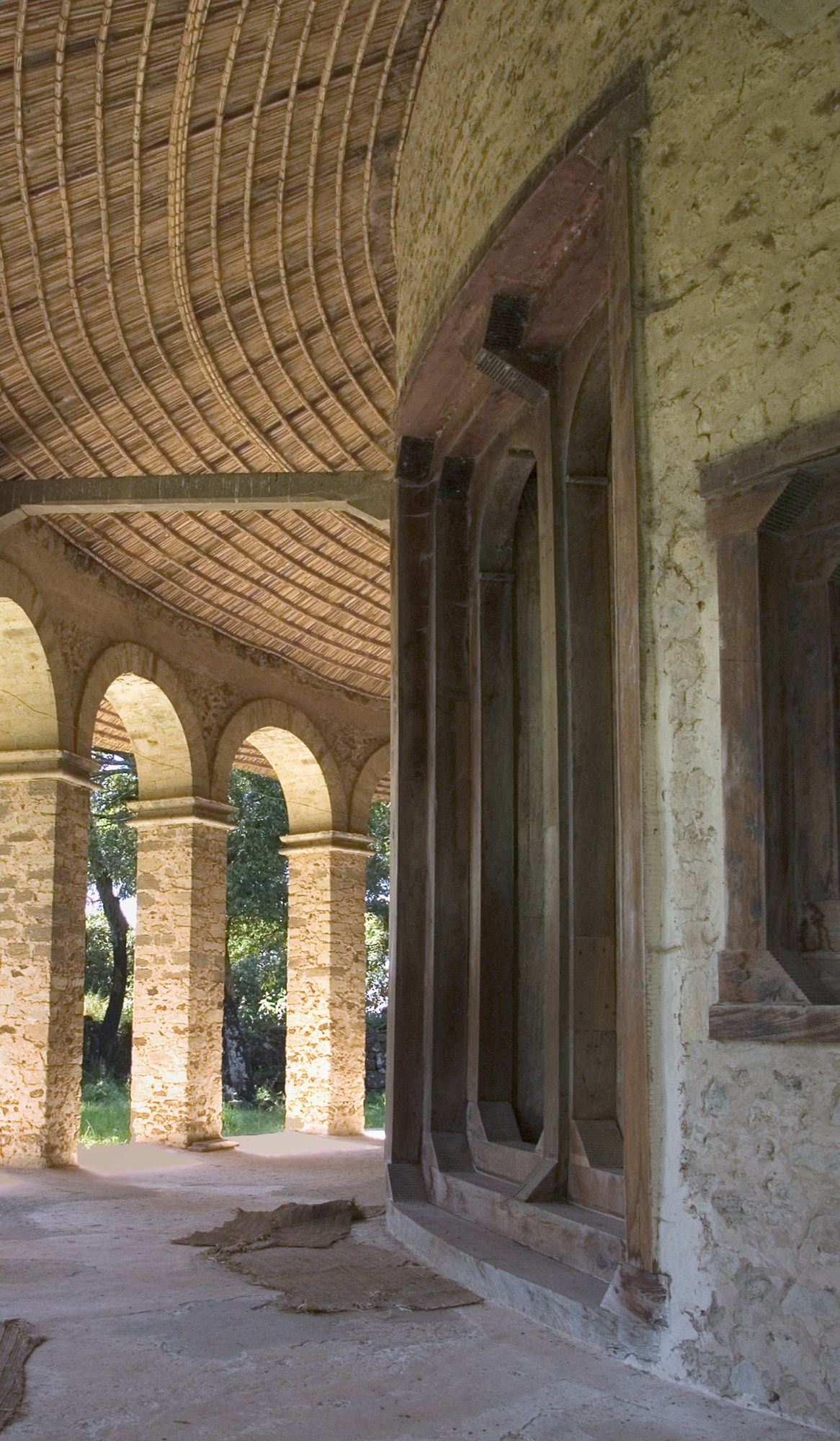
Work on the whole compound took more than a decade, until 1750, according to Bosc-Tiessé. At its centre is a large round church of stone and lime, built on a central plan; its sanctuary is called the maqdas. Ura Kidane Mehret, another painted church on the lake, is also round. In a 2000 survey of twenty Lake Tana churches, based on fieldwork in 1997 and 1998, Bosc-Tiessé records their founding traditions, architecture, paintings and treasures.
Paintings and politics
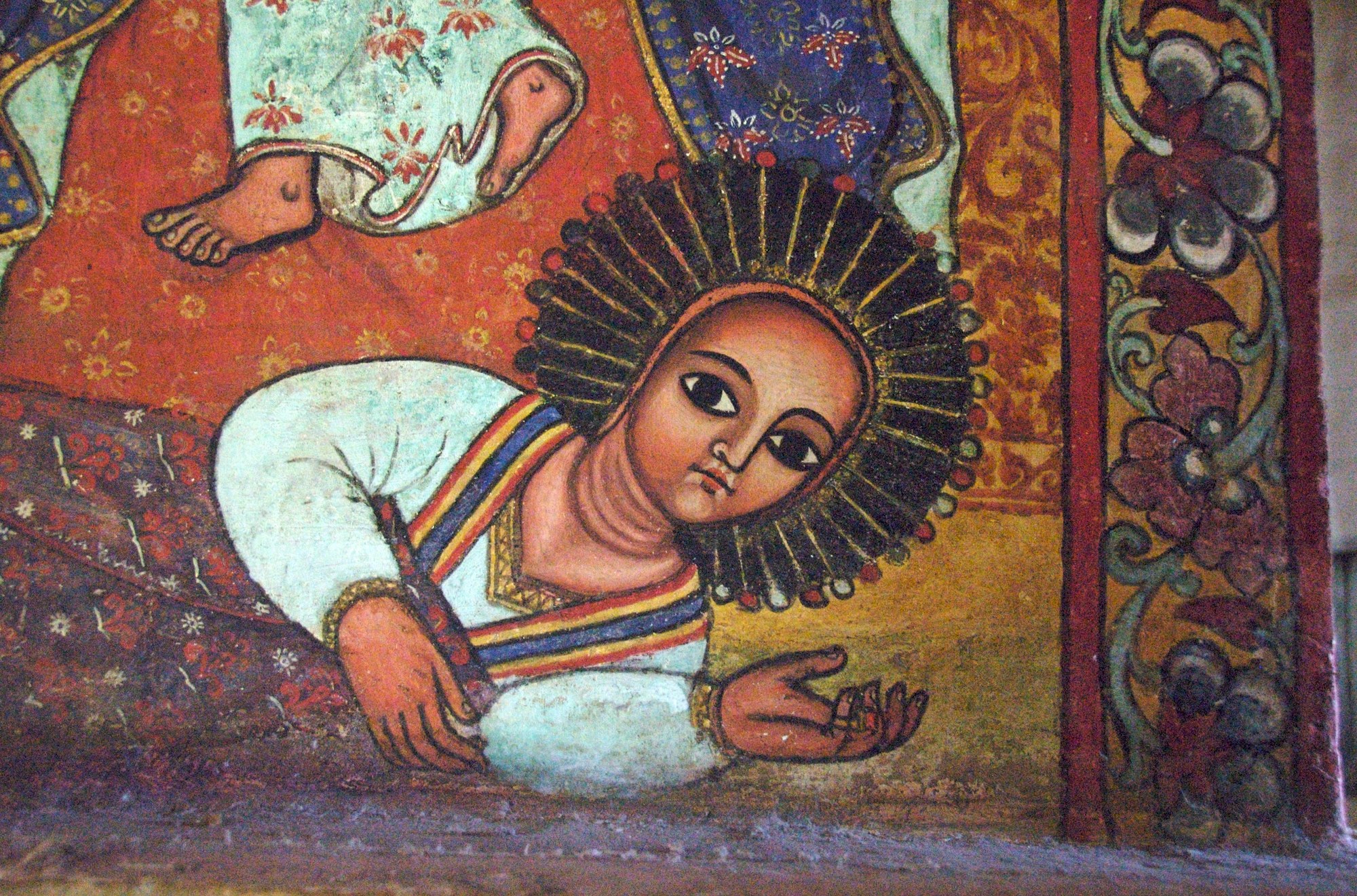
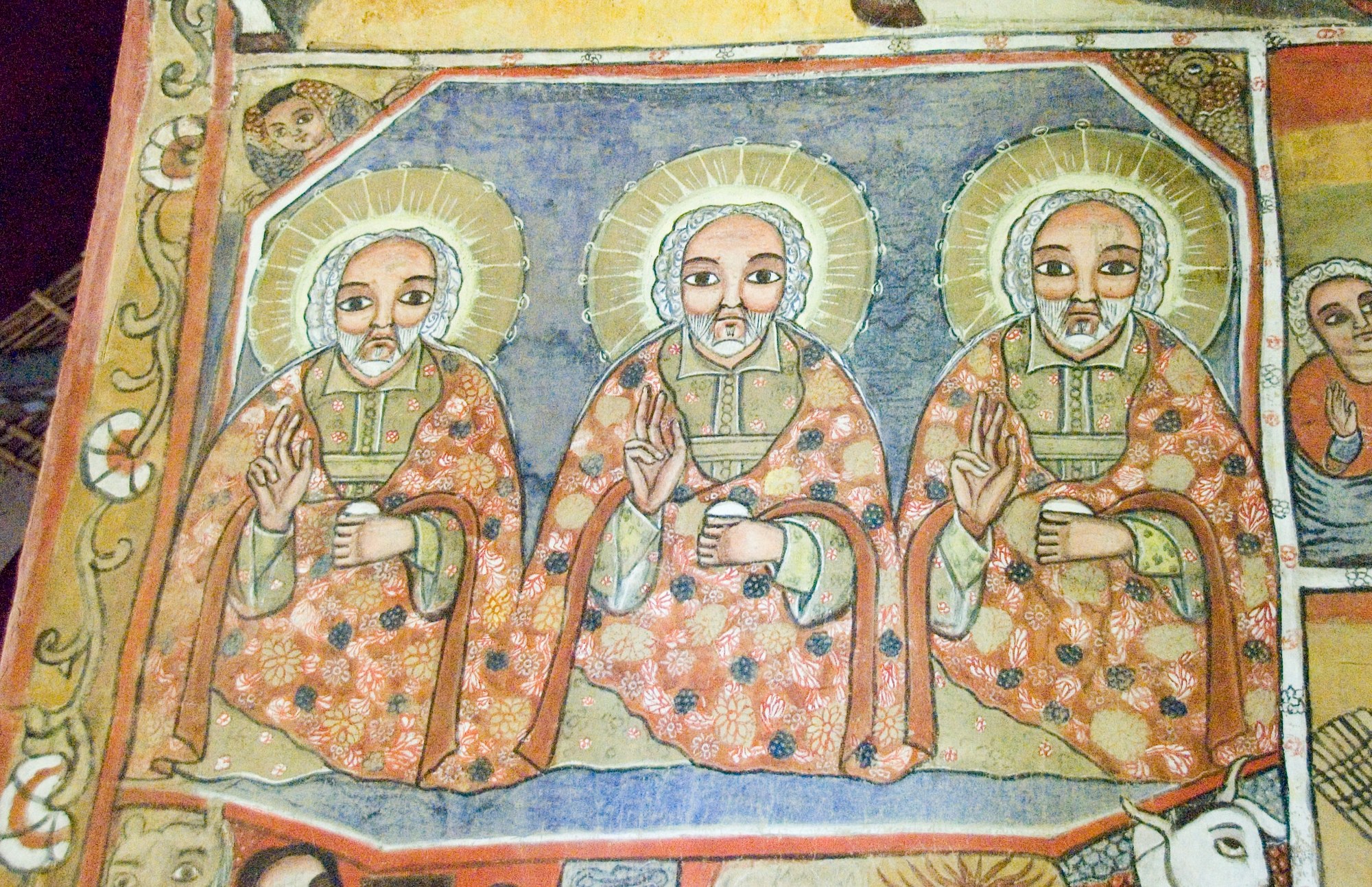
Under Mentewab’s supervision, the church was decorated with carvings in wood and stone and with murals on the outer walls of the maqdas, the encyclopedia says. Its painters drew on illuminated manuscripts from Bakaffa’s reign, the paintings of Mentewab’s other royal foundation at Qwesqwam in Gondar, European engravings, especially copies of a book conceived by the Jesuit Nadal, and the Dutch earthenware tiles used at Qwesqwam. Berry adds that the wall paintings most probably reflect her own taste. Some parts were repainted later, and the church was partly restored under Emperor Haile Selassie I in the 1950s. For another Gondarine painted interior, see Debre Berhan Selassie.
The church was also an instrument of power. Its incomes were listed in the foundation text and revised several times, Bosc-Tiessé writes, and the main beneficiaries were Mentewab’s family, her allies and clerics of the Ewostatean movement. Mentewab and Iyasu II also gave it books and liturgical objects. Reviewing Bosc-Tiessé’s 2008 book on the Lake Tana churches, the historian Anaïs Wion notes that Iyasu II’s royal chronicle never mentions the foundation. She also summarises the book’s argument that Mentewab, whom Berry describes as an adherent of the Qebat doctrine, planted at Narga a political and religious centre that rewarded her closest circle and the monastic network she favoured.
Sources
- Claire Bosc-Tiessé, “Narga Śǝllase”, Encyclopaedia Aethiopica, volume 3 (Wiesbaden: Harrassowitz, 2007), pages 1148 to 1149.
- Ewa Balicka-Witakowska, “Däq”, Encyclopaedia Aethiopica, volume 2 (Wiesbaden: Harrassowitz, 2005), page 93.
- LaVerle B. Berry, “Bǝrhan Mogäsa”, Encyclopaedia Aethiopica, volume 1 (Wiesbaden: Harrassowitz, 2003), pages 534 to 535.
- Ignazio Guidi (ed.), “Il Racconto di Nārgā”, Rendiconti della Reale Accademia dei Lincei, series 5, volume 14 (1905), pages 233 to 267 (https://archive.org/details/s5rendicontidell14accauoft)
- Claire Bosc-Tiessé, “L’histoire et l’art des églises du lac Ṭana”, Annales d’Éthiopie 16 (2000), pages 207 to 270
- Anaïs Wion, review of Claire Bosc-Tiessé, Les Îles de la mémoire. Fabrique des images et écriture de l’histoire dans les églises du lac Tānā, Éthiopie, XVIIe-XVIIIe siècle (Paris: Publications de la Sorbonne, 2008), Gradhiva 12 (2010)